
Digital Humans for Customer Engagement: Uses and Benefits

Updated: 6 days ago

Digital humans are computer-generated characters designed to communicate through a recognizable face, voice and personality. When connected to conversational AI, they can listen, respond and guide people in real time. This combination turns a traditional interface into a visible assistant that can explain information, ask follow-up questions and help a user complete a task.
For customer engagement, the opportunity is not to imitate a person in every detail. It is to make a digital interaction clearer, more memorable and easier to navigate. A well-designed digital human can create continuity across a website, kiosk, event, training experience or virtual world while keeping approved information and brand behaviour consistent.
This guide explains how AI-powered digital humans work, where they improve engagement, which use cases are most practical and how to evaluate the technology responsibly. It also distinguishes live digital humans from scripted avatars so teams can choose the right format for each customer journey.
Table of contents
What Are AI-Powered Digital Humans?

An AI-powered digital human is a visual character controlled by software that can generate or deliver speech, display synchronized animation and respond to a user’s input. The character may look realistic, stylized or completely fictional. What makes it useful is the connection between visual performance and an intelligent conversation or content system.
The term covers more than one format. A scripted digital presenter can turn approved text into repeatable video. A live conversational digital human can respond during an interaction. A performance-driven character can be controlled by an actor through motion capture. These approaches can also be combined, but they have different cost, latency and quality requirements.
For a live experience, the system typically includes speech recognition, natural-language understanding, retrieval from a controlled knowledge source, response generation, text-to-speech and facial or body animation. Business integrations can add scheduling, search, customer-support context or other actions. The visual character becomes the interface; it does not replace the need for accurate information and safe system design.
Digital humans are related to AI avatars, but the terms are used differently across the market. “Digital human” often emphasizes lifelike presence, communication and character design, while “AI avatar” can include a broader range of visual agents and generated presenters. The practical question is the same: what interaction should the character improve? Read what an AI avatar is for the broader definition.
They should also be distinguished from autonomous agents. An agent may plan tasks or call tools without a visible body. A digital human can present and explain what an agent is doing, but the interface itself is not automatically autonomous. The guide to AI agents vs AI avatars explains this separation.
Scripted presenter: delivers approved content consistently at scale.
Conversational digital human: handles a two-way exchange in real time.
Performance-driven character: captures an actor’s expression, voice or movement.
Hybrid experience: combines prepared content, live conversation and human escalation.
Why Digital Humans Can Improve Customer Engagement

Customer engagement improves when people understand what to do, feel confident continuing and receive information at the right moment. A digital human can support these conditions by using voice, expression, visual focus and step-by-step guidance instead of relying on dense text or nested menus.
The visible character gives the interaction a clear focal point. On a public display, kiosk or immersive screen, that presence can help a visitor recognize that assistance is available. On a website, a digital human can introduce a complex service and then move out of the way when the user prefers a faster text or form-based route.
Voice can reduce friction for users who find typing inconvenient, while captions and a text option preserve accessibility. The character can explain unfamiliar terms, repeat a step or provide a shorter version. Because the system can ask clarifying questions, it can narrow the information instead of presenting every option at once.
Consistency is another advantage. A digital human can use approved language across locations, devices and operating hours. That is useful for onboarding, compliance explanations, product launches and multilingual campaigns. Consistency should not become rigidity: the conversation needs to adapt to user intent while remaining grounded in reviewed content.
Personalization can make the experience more relevant, but it should be transparent and proportionate. The system can adapt language, topic sequence or recommended content based on what the user states during the session. Using stored personal data requires clear consent, security and a meaningful benefit.
The strongest engagement is outcome-oriented. Longer conversations are not automatically better. A digital human should help a customer find an answer, understand a choice, complete a step or reach the right person. The related article on conversational AI avatars covers the real-time interaction layer in detail.
High-Value Use Cases for Digital Humans

Digital humans work best where visual explanation, brand presence or guided conversation adds value beyond a standard interface. Start with a journey that already has clear demand and known questions. The character should improve that journey rather than create an extra step.
In customer service, a digital human can handle common information requests, collect context and explain a process before handing the conversation to a person. It can be available across time zones without pretending to replace human judgment. The most reliable design keeps escalation visible and sends the human agent a concise summary.
In retail and e-commerce, the character can guide product discovery, explain differences and answer questions about fit, features or availability. A branded digital human can also support campaigns or livestreams. Recommendations should be based on stated preferences and trustworthy product data, not hidden assumptions. See how AI is changing retail.
In education and workplace learning, a digital instructor can deliver scenarios, demonstrate procedures and support practice. Learners can ask for another explanation without social pressure. The system still needs instructional objectives, expert-reviewed content and a way to measure learning. Explore AI avatars for education for a focused treatment.
In financial services and healthcare, digital humans can make complex information easier to understand, but the role must be tightly defined. They can explain general processes, guide navigation and help users prepare questions. They should not imply professional advice or make unsupported decisions. Strong authentication, privacy controls and human escalation are essential.
In events and exhibitions, a digital human can welcome visitors, present a product repeatedly and route qualified interest to the right team. The deployment should account for noise, lighting, queues and connectivity. A short, compelling first interaction often works better than an open-ended demonstration.
In entertainment, gaming and virtual worlds, digital humans can become interactive hosts, performers or non-player characters. Here the design challenge includes personality, narrative continuity and performance quality. Read about AI NPCs in gaming and virtual brand ambassadors for adjacent applications.
Customer support: guided answers, triage and human handoff.
Retail: product discovery, explanation and campaign engagement.
Learning: instruction, role-play and repeatable practice.
Events: welcome, product demonstration and lead routing.
Entertainment: interactive characters, hosts and story experiences.
Enterprise communication: onboarding, policy explanation and internal assistance.
Technology, Integrations and Responsible Governance

A digital human experience is a system of coordinated components. The character and rendering layer must work with speech, conversation, knowledge and business systems. Evaluating only the visual demo can hide weaknesses in latency, answer quality or operational control.
For scripted video, the pipeline may begin with approved copy and end with synthesized voice and animation. For live conversation, the system also needs speech recognition, intent detection, context management, retrieval and response generation. Each stage should be monitored because an error early in the pipeline affects everything that follows.
Knowledge grounding is critical. The digital human should retrieve from current, approved sources and cite or identify those sources when appropriate. A content owner must be able to update the knowledge without rebuilding the character. The system should admit when the answer is unavailable instead of filling a gap with plausible language.
Integrations determine whether the experience can do useful work. A support assistant may connect to a help center and ticketing system. A retail assistant may connect to product data and inventory. A training character may connect to a learning platform. Each connection needs least-privilege access, confirmation for sensitive actions and an audit trail.
Privacy should be designed into the journey. Collect only the data needed for the task, state how it will be used and provide a non-voice option when possible. If recordings or transcripts are retained, define a clear retention purpose and access policy. Biometric interpretation and emotion detection require especially careful legal and ethical review.
Disclosure is straightforward but important: users should know the character is AI-driven. The design should avoid deceptive claims about identity, expertise or human oversight. For brand characters, usage rights for likeness, voice and creative assets must be documented.
Moderation and escalation protect both users and the organization. The system needs boundaries for harmful input, unsafe output, personal data and off-topic requests. It should provide a brief safe response and a route to a qualified person when the situation requires judgment.
How to Plan and Measure a Digital Human Deployment

Begin with one audience, one journey and one measurable outcome. Instead of launching a general digital employee, define a focused role such as explaining a product line, guiding event visitors or preparing support context. Narrow scope makes accuracy, testing and ownership easier.
Map the conversation from the user’s perspective. Identify the questions they bring, the information the system may use, the decisions it can support and the points where a human should take over. Write success criteria before choosing the visual style or platform.
Build a test set from real language, including short questions, vague requests, interruptions, accents and unexpected topics. Review factual accuracy, tone, latency, turn-taking, captions and fallback behaviour. Test on the actual device and network, not only in a studio environment.
Choose metrics that reflect the job. For support, measure successful resolution, appropriate escalation and user effort. For learning, measure completion, comprehension and retention. For events, measure meaningful conversations and qualified handoffs. For retail, measure successful discovery and assisted conversion.
Run a controlled pilot and review transcripts with the team that owns the underlying service. Fix knowledge gaps and interaction friction before adding more channels. A digital human can scale quickly only when content, permissions and quality review scale with it.
Mimic Minds combines character design, real-time technology, conversational systems and production experience. That makes it possible to build a coherent digital human rather than assembling an interface and personality as separate afterthoughts. To understand the production side, explore how motion capture supports AI avatars.
Define: one role, audience, channel and measurable outcome.
Ground: connect only reviewed information and approved actions.
Test: use real questions, devices, environments and failure cases.
Govern: assign owners for content, privacy, safety and operations.
Improve: review evidence and expand only after reliability is proven.
Designing Digital Humans for Customer Engagement
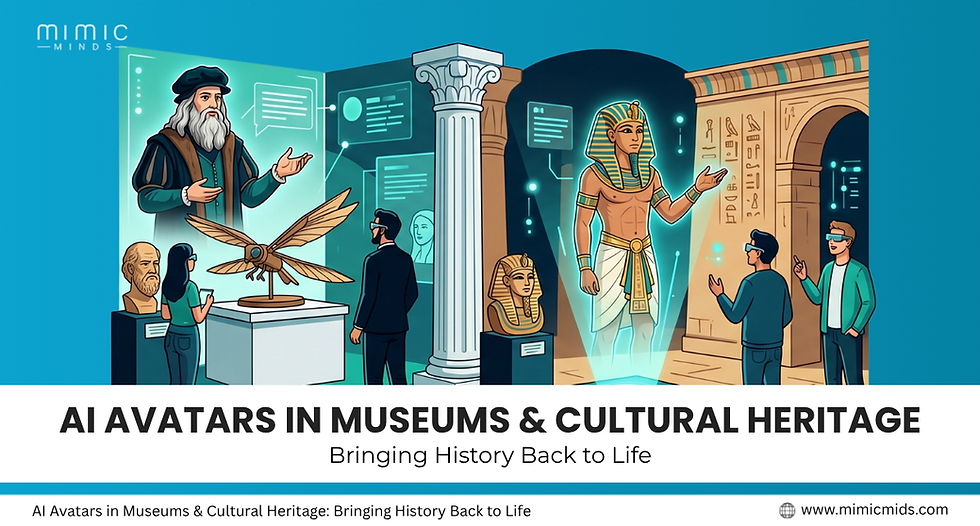
Digital humans are interactive virtual characters that combine a visual identity with speech, language understanding and real-time response. In customer engagement they can welcome visitors, explain products, answer common questions, support onboarding or hand a conversation to a person. Their purpose is not to imitate a human secretly, but to create a clear and approachable interface for complex information.
A useful digital human needs more than realistic graphics. It requires accurate knowledge, fast responses, natural turn-taking, accessible interaction and a defined role. The character's appearance and personality should match the brand and audience, while its language should remain direct and easy to understand. Visual quality matters, but reliability determines whether customers return.
Planning, Governance and Integration
The experience should be designed around customer intent. A shopper comparing products needs different information and actions from a new employee completing training or a visitor checking into an event. Mapping the questions, decisions and transitions in each journey prevents the digital human from becoming a generic layer that adds friction.
Trust depends on transparency and control. Users should know they are interacting with a digital system, what information it can access and how to reach a person. The character should acknowledge uncertainty, avoid unsupported claims and never pressure someone to share unnecessary personal data. Consent is especially important when voice, camera or identity data is involved.
Give the digital human one clear role and audience.
Connect responses to verified knowledge and current business data.
Use transparent disclosure and simple human handoff.
Test voice, timing, accessibility and behavior on target devices.
Measure customer outcomes, not visual novelty alone.
Measurement and Responsible Deployment
Integrations turn conversation into service. Product catalogs, booking systems, knowledge bases and customer platforms can provide current information, but permissions must be narrow and monitored. Sensitive transactions should require authentication and confirmation, and the user should receive a clear record of important actions.
Measure outcomes across the entire journey. Engagement time is useful only when it leads to better understanding, resolution, conversion or satisfaction. Teams should also track latency, abandoned conversations, escalation quality and the questions the system fails to answer.
Related Mimic Minds Guides
Frequently Asked Questions
What is a digital human?
A digital human is an interactive virtual character that combines a visual representation with voice, conversational AI and real-time behavior.
How do digital humans improve customer engagement?
They can make information easier to navigate, provide consistent guidance and create a more personal interface for sales, service or onboarding.
Are digital humans the same as chatbots?
No. A chatbot is usually text based, while a digital human adds a visual character, voice, expression and embodied interaction.
Can a digital human connect to business systems?
Yes. Controlled integrations can retrieve product, booking, policy or customer information and initiate approved workflows.
Should users know they are speaking with AI?
Yes. Clear disclosure supports trust and helps users make informed decisions about the interaction.
Can digital humans replace customer-service teams?
They can handle bounded, repeatable tasks, but complex, sensitive and exceptional situations still need skilled people.
How are digital humans measured?
Track task completion, resolution, conversion, satisfaction, escalation, latency and accuracy rather than engagement alone.
What makes a digital human feel natural?
Responsive timing, appropriate eye contact, clear speech, useful answers and graceful handling of uncertainty matter more than photorealism alone.
Conclusion
AI-powered digital humans can make digital journeys more understandable and engaging by combining live language with a visible, designed character. Their impact depends on accurate knowledge, responsive interaction, responsible data use and a clear job within the customer journey.
Start with a focused experience that solves a real problem, test it with representative users and measure the outcome rather than novelty. If a digital human is the right interface, Mimic Minds can help design the character, conversation and deployment as one system. Explore Mimic AI Studio or contact the team.

Comments