
Real-Time AI Avatar vs Pre-Recorded: Which One Does Your Business Actually Need?

Updated: 5 hours ago

Do you need a real-time AI avatar that can listen, respond, and guide people in the moment, or do you simply need a polished avatar video that delivers the same message every time?
That decision shapes everything: your content process, your risk model, your integration stack, and what “success” looks like after launch. In practice, most teams are not choosing between two visuals. They are choosing between two interaction models. One model is conversational, adaptive, and measurable in live outcomes. The other is fixed, editorially controlled, and measured like media.
Important note up front: Mimic Minds is built for live, interactive deployments. We specialize in conversational digital humans that look, sound, and act like your brand, powered by real-time speech and language pipelines. We do not position ourselves as a pre-recorded avatar production house. When this article mentions pre-recorded content, it is as a baseline comparison many businesses consider, not as a service we sell.
Table of Contents
The Real Decision You Are Making
A real-time AI avatar is not “a video that talks.” It is a system that listens, decides, and speaks with guardrails. Pre-recorded avatar content is a deliverable: you approve the script, render the output, and publish it.
If you want a clean way to choose, map your need to one of these business realities.
1. If your audience asks questions, you need interaction
The moment a customer asks “Does this apply to me?” a static asset cannot adapt. A real-time AI avatar can, because it is designed for dialogue, follow ups, and clarification.
2. If your message must be identical every time, you need a locked narrative
Compliance, legal statements, investor messaging, and regulated disclosures often require fixed delivery. That is the natural home of pre-recorded content.
3. If you need integration, you need a live brain
The value of an interactive AI avatar increases when it can access product catalogs, schedules, policies, CRM notes, or knowledge bases. This is where a conversational AI agent becomes operational, not just informational.
4. If you need scale across touchpoints, you need a platform
A single video can scale as media. A fleet of live avatars needs analytics, versioning, role configuration, and updates. That is platform territory.
Think of it like production. A film trailer is edited for precision. A live performance needs rehearsal, cues, and a stage manager. Both can be high quality. They are simply built for different outcomes.
Real-Time AI Avatars: What They Are and Why They Work

A real-time AI avatar is an embodied conversational layer that combines four core components: perception, reasoning, performance, and policy.
1) Perception: hearing and understanding people
In live deployments, users do not type like they write. They interrupt, change topics, speak with background noise, and use informal language. A reliable live avatar AI system needs speech to text that handles real environments and logic that manages turn taking.
Microphone and acoustic conditions
Timing rules for interruptions and silence
Confidence thresholds that trigger clarifying questions
Multilingual behavior that stays on brand
2) Reasoning: the conversational engine
Under the hood, an interactive AI avatar typically runs on a language model with retrieval and memory behaviors. The best results come from designing the conversation like a role, not like a chatbot prompt.
Intent mapping for common requests
Retrieval that cites internal sources, not guesses
Short term memory that respects privacy
Tool access for actions like booking, searching, or escalation
This is also where you decide whether you are building a simple talking FAQ or a conversational AI agent that can complete workflows.
3) Performance: the face, the voice, the timing
Once you give an agent a face, humans judge it like a performer. A believable real-time AI avatar depends on timing as much as rendering.
Natural pauses and acknowledgments
Lip sync that matches cadence, not just phonemes
Expression control that avoids repetitive loops
A voice identity that fits the character’s role
4) Policy: safety, consent, and brand control
Live systems must be governed. The safest real-time deployments are designed with constraints that are visible in the experience.
Clear refusal behaviors for restricted topics
Escalation pathways to humans
Tone boundaries for sensitive contexts
Auditability through logs and analytics
When these four layers work together, a real-time AI avatar becomes a usable interface, not a novelty.
When Pre-Recorded Content Still Wins

Even if your business is excited about conversational digital humans, there are moments where fixed delivery is the correct decision.
Regulated messaging and compliance statements: If content must be approved word for word, fixed media is easier to validate.
High polish brand films: When you need cinematic lighting, perfect pacing, and crafted storytelling, pre rendered media often delivers the most control.
Short campaigns with no need for Q and A: If the audience does not need to ask anything, interactivity can be unnecessary.
This is not an argument against real-time AI avatars. It is a reminder that the highest performing solution is the one aligned to the job to be done.
What Mimic Minds Provides
Mimic Minds focuses on real time, interactive deployments that can live on websites, kiosks, and enterprise workflows. We treat avatars like production characters and treat the underlying intelligence like a governed system.
If you want a single place to build, configure, and deploy, Mimic AI Studio is our creation and deployment suite designed for role based configuration, LLM connectivity, and real-time TTS and STT pipelines.
Real-time conversational avatars built for business outcomes
Characters that match brand identity, from photoreal humans to stylized personas
Voice, attitude, and behavior configuration so the avatar sounds consistent
Embeddable widgets for web deployment with practical setup workflows
Analytics for measuring engagement, completion, and iteration opportunities
Agentic capability for workflows, not just talk
Many businesses want more than conversation. They want actions: scheduling, routing, lead qualification, knowledge retrieval, and task completion. That is where our Agents approach supports tool connections and structured behaviors that turn a conversational AI agent into a reliable digital worker.
Enterprise readiness and governance
If your deployment needs organization wide controls, permissioning, monitoring, and operational confidence, Enterprise solutions provide the foundation for scalable rollout.
Use case specific solutions
For customer facing implementations, AI avatars for business maps the real-world needs of support, sales assistance, and onboarding into practical avatar roles.
If you are evaluating a rollout and want to discuss constraints like compliance, integration, or on site conditions, the most direct path is to contact our team and outline the environment you are deploying into.
Applications Across Industries

A real-time AI avatar earns its keep where humans hesitate, get confused, or need reassurance. The avatar becomes the calm interface that keeps the journey moving.
Below are common patterns across sectors. For a wider view of role based deployments, explore industries we support and match the avatar’s persona to the environment, not just the brand style.
Retail and shopping guidance: Product discovery, comparison support, and store kiosk assistance where customers want quick answers without searching menus.
Enterprise customer support: First contact triage, policy explanation, troubleshooting steps, and escalation routing to human teams when needed.
Healthcare and wellness education: Non clinical guidance, appointment preparation, and program onboarding with careful tone control and clear boundaries.
Mobility and public facing services: Wayfinding, transit assistance, and service explanations in noisy environments where voice interaction feels natural.
Education and training: Tutoring support, onboarding simulations, and roleplay practice where the learner benefits from responsive dialogue.
Events and brand activations: Trade show engagement, booth guidance, and lead qualification that feels like a conversation instead of a form.
Across these contexts, the same logic holds: if the experience depends on interaction, a real-time AI avatar is the correct foundation.
Benefits

When implemented with production discipline and governance, real-time conversational avatars deliver benefits that show up in both experience and operations.
Higher engagement without forcing a chat box: Faces and voices draw attention, but the real value is clarity. People stay when they feel understood.
Better conversion by answering objections in the moment: A live avatar AI system can handle the questions that typically cause drop off: pricing, eligibility, process steps, timing, and next actions.
Operational efficiency with respectful escalation: Repetitive requests can be resolved instantly. Complex or sensitive requests can be routed to humans with context intact.
Continuous improvement through analytics: Because interactions are measurable, you can refine knowledge, tone, and flows based on what users actually ask.
Consistent brand performance at scale: A well designed interactive AI avatar delivers a consistent personality and policy alignment across channels, even as content updates.
Future Outlook
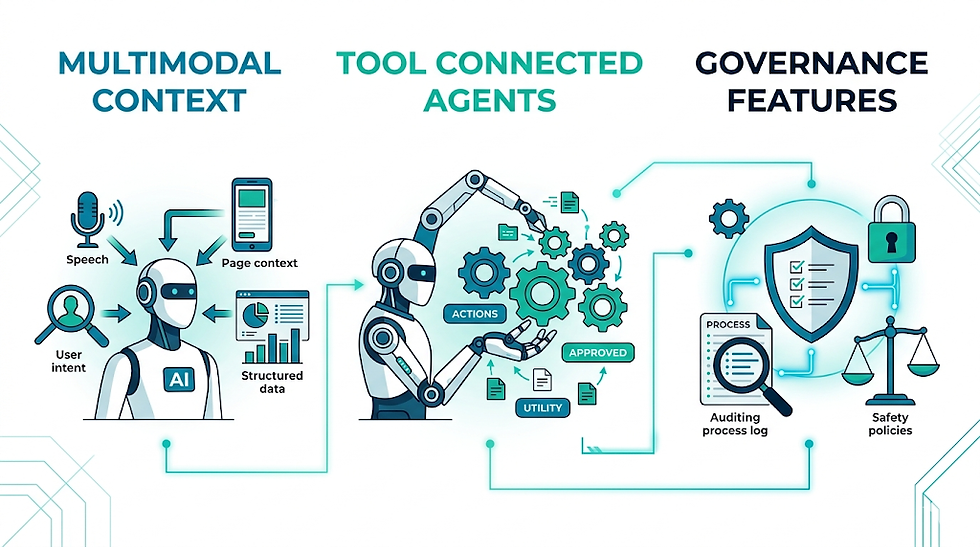
The future of real-time AI avatars is less about visual realism and more about reliability. The winning systems will feel human because they behave responsibly: they ask better questions, retrieve accurate information, and know when to stop.
Three shifts are already shaping what businesses should plan for.
Multimodal context will become standard: Avatars will interpret not just speech, but situational signals such as page context, user intent patterns, and structured data.
Tool connected agents will define utility: A conversational AI agent that can safely take actions inside approved systems will outperform a purely informational avatar.
Governance will become a core product feature: Auditability, permissioning, and safety policy design will matter as much as animation and voice.
In short, real-time AI avatar deployments will look less like marketing experiments and more like mature digital interfaces that sit alongside web apps, customer portals, and service desks.
A Decision Framework for Real-Time or Pre-Recorded Avatars
Choose real time when the audience must ask unpredictable questions, receive personalized guidance or complete tasks through connected systems. Choose prerecorded content when the message is stable and tightly controlled.
Real-time experiences require latency management, approved knowledge, moderation, privacy controls and recovery when speech recognition or tools fail. Prerecorded content shifts effort toward scripting and version management.
A hybrid approach can use polished recorded segments for introductions or compliance information, then switch to conversation for bounded questions. This preserves control while allowing useful interaction.
Compare total ownership rather than one production cost. Include updates, infrastructure, integrations, review, analytics and human escalation, then pilot the smallest version that tests the outcome.
Practical Takeaways
Match the format to the audience task.
Account for operational requirements.
Use hybrid journeys when both are needed.
Pilot and compare total ownership.
Related Mimic Minds Resources
FAQs
What is a real-time AI avatar in business terms?
A real-time AI avatar is a digital character that can listen and respond instantly using speech and language pipelines, often connected to knowledge and tools so it can guide users and complete tasks.
Is an interactive AI avatar better than a chatbot?
Not always. If your audience is comfortable with text, a chatbot can work. An interactive AI avatar is most valuable when attention, trust, and guided dialogue matter, such as kiosks, onboarding, support, and sales assistance.
What is live avatar AI used for most often?
Common use cases include customer support triage, product guidance, lead qualification, training Q and A, event engagement, and website assistance.
Do I need an AI agent or just an avatar?
If you only need answers, an avatar with retrieval can be enough. If you need actions like booking, routing, updating records, or triggering workflows, you want a conversational AI agent with tool connections.
How do you keep a real-time AI avatar safe and on brand?
Through role design, guardrails, refusal behaviors, escalation paths, and ongoing monitoring. In live systems, quality control is policy and behavior design, not only script review.
Can real-time AI avatars work on websites?
Yes. Embeddable deployments are common for product guidance and support. The key is designing the conversation around intent and integrating the right knowledge sources.
How do I know if I should avoid pre-recorded and go fully real time?
If your users ask questions, need personalization, or require workflow help, real-time is the stronger fit. If you only need a fixed message, interactivity may add complexity without ROI.
What should I prepare before launching?
Define the avatar’s role, tone boundaries, key intents, knowledge sources, and escalation rules. Then measure real interactions and iterate based on analytics.
Conclusion
The choice is not really real-time AI avatar versus pre-recorded visuals. The choice is responsiveness versus fixed delivery. If your business needs conversation, personalization, and measurable outcomes inside real journeys, a real-time AI avatar is the right foundation.
Mimic Minds is built for that reality: interactive AI avatars that behave like reliable interfaces, not one off media assets. With a studio grade approach to character craft and a governed approach to conversational intelligence, you can deploy a digital human that feels natural, stays on brand, and actually helps people move forward.
For further information and in case of queries please contact Press department Mimic Minds: info@mimicminds.com


Comments