
3D AI Avatars vs 2D Talking Avatars: Which to Choose?

Updated: 7 days ago

In This Guide
The difference between 2D and 3D avatars is how the character is represented and rendered. A 2D avatar appears as an image, video or two-dimensional animation; a 3D avatar uses a model that can be viewed and animated in three-dimensional space.
Either format can deliver a prerecorded presentation or connect to a live conversational system. AI capability, memory and tool use are separate decisions from dimensionality. Choose 3D when spatial movement, camera freedom or integration into a 3D scene matters; evaluate 2D when a screen-based presentation meets the brief.
This guide is built for buyers who want clarity, not a tech demo. We will compare 2D vs 3D avatar options through practical lenses: cost, speed, realism, interactivity, deployment, maintenance, and the long-term value of building a 3D digital human that can scale across channels without redoing the whole asset.
Table of Contents
What Businesses Really Mean When They Say “Avatar”
In procurement conversations, the word avatar often hides three different expectations.
A presenter who reads scripts for marketing, onboarding, and internal communications
A conversational interface that can answer questions with voice and personality
A character that can exist in spatial contexts such as VR, AR, games, simulators, and real-time 3D worlds
A 2D talking avatar can present scripts or support live conversation when connected to an appropriate system. Its visual output is an image, video or two-dimensional animation; that does not set a limit on the conversational model behind it.
A 3D model supports spatial movement, changing viewpoints and placement inside a 3D scene. Live conversation still depends on the connected system, and deployment in another engine or device may require asset adaptation.
When businesses come to Mimic Minds, we usually start by clarifying where the avatar will live. A website, an app, an event screen, a retail kiosk, or a headset each imposes different requirements. If your avatar is meant to operate as a front-line interface, the criteria should look more like product architecture than marketing content. This is where an enterprise path such as the solutions described in the enterprise deployment options becomes relevant because lifecycle, governance, and scale matter as much as aesthetics.
2D Talking Avatars Explained

A 2D talking avatar is usually a facial performance rendered in a fixed view. Think of it as a high-control presenter format.
What it is in practical terms
A video-like experience, often framed as head and shoulders
Lip sync driven by text to speech
Expressions driven by a template rig or face tracking
Often delivered as prerecorded clips or as lightweight real-time playback
What 2D does exceptionally well
Speed to launch for training, announcements, and product explainers
Consistent framing and lighting, which simplifies brand approvals
Lower compute demands and simpler embedding on websites
Easier localization workflows for multilingual marketing
Where 2D becomes limiting
Fixed camera and limited body language
Less convincing spatial presence in interactive contexts
Harder to reuse the asset across environments without reauthoring
Conversation can feel disconnected if the character cannot “live” in the UI as a responsive being
If your primary goal is to scale spokespeople style content, a 2D format can be an efficient start. Many teams use it as a stepping stone before they commit to a more embodied character. For buyer-friendly use cases, the service direction is usually closer to what Mimic Minds outlines for customer-facing deployments such as AI avatars for business, where speed and clarity often matter more than full embodiment.
3D AI Avatars Explained

A 3D AI avatar is a character built with a full 3D asset pipeline. It is not just a face, it is a rigged model with a body, a skeletal structure, blendshapes for expressions, and animation systems for gestures and posture.
When the goal is a 3D digital human that can interact naturally, the avatar becomes a system.
What it is in production terms
A 3D model with topology suitable for deformation
A facial rig and expression library for emotional range
A body rig with animation layers for idle, gesture, turn, and attention
A real-time runtime, often paired with conversational AI, speech to text, and text to speech
Optional performance capture inputs for high fidelity acting
Where a 3D model adds value
Spatial presence in VR, AR, kiosks, and simulated environments
Camera freedom for product demos, cinematic angles, and experiential design
Consistent character identity across content, UI, and interactive sessions
Spatial gaze and gestures; conversation and turn-taking require separate integration
The tradeoffs
Higher upfront build cost because you are creating a reusable asset
More decisions about realism and the uncanny valley risk
More engineering considerations for real-time rendering and deployment
Ongoing character maintenance as your brand evolves
For businesses that plan to use interactive characters as a durable interface, a real-time 3D avatar is closer to a long-term digital employee than a campaign deliverable. That is why many teams evaluate this decision alongside internal AI agent strategies, especially when an avatar is expected to speak and act with autonomy. If your roadmap includes avatars as operators, guides, or assistants, the system approach described in Mimic Minds agents is often part of the same conversation.
How to Choose: Decision Factors That Matter in Procurement

Choosing between a 2D vs 3D avatar is less about visuals and more about what you want the interface to do.
1. Interaction depth: presentation vs participation
If you need scripted delivery, 2D is efficient.
If you need contextual dialogue or memory, specify those capabilities in the conversational system for either format. Choose a 3D character when its spatial gestures, gaze or movement improve the experience.
2. Channel strategy: one screen vs many environments
2D works best when your avatar lives in a single frame on a page or inside a video funnel. A 3D digital human works best when your character needs to move across touch screens, large displays, kiosks, VR, and possibly games.
If you already have metaverse or XR ambitions, the choice is often made for you. A 2D talking avatar can appear inside a 3D space as a screen, but it will behave like a screen. A 3D character can behave like a being.
3. Realism and trust requirements
Some industries gain trust through clarity and warmth rather than photorealism. In many customer-facing contexts, a stylized character can outperform a hyper-real face because it avoids uncanny responses.
For experience design teams, this is where the “talking avatar vs digital human” question becomes brand strategy. If you want lifelike empathy, you need more than lip sync. You need believable timing, micro expressions, and conversational turn-taking. Those are performance problems, not only rendering problems.
4. Build once vs rebuild repeatedly
A strong reason to choose a 3D AI avatar is reuse. Once you own a robust rig and a stable look, you can retarget animations, change wardrobe, adjust environments, and film new sequences without recreating the character.
A 2D avatar can also be reused, but it is often tied to a fixed view and a narrow expression set. When the requirements expand, teams frequently hit a ceiling and end up rebuilding anyway.
5. Time to value and stakeholder tolerance
A fixed-view presenter may reduce production work, but delivery time depends on the assets, approvals and integrations required.
For a flagship interface, compare both formats against the intended experience, performance budget and maintenance requirements.
The most buyer-friendly approach is sometimes phased: launch a 2D presenter for immediate wins, then build the 3D digital human that becomes the durable interface when product and engineering are ready.
Separate visual format from conversational capability
A 2D character connected to the same language model and approved knowledge as a 3D character can answer the same questions. Conversely, a rendered 3D video has no live conversational ability. Specify both the visual asset and the interaction system in the project brief.
For example, a prerecorded product explanation may only need a fixed-view presenter. A guide that walks beside a learner in a 3D simulation needs a spatial model and animation. A support assistant on a web page could use either format; test whether the character helps people finish their task.
What determines the cost?
For 2D, compare asset creation, voice rights, video or animation production, licensing, localization and delivery costs. For 3D, also consider modeling, texturing, rigging, animation, rendering and target-device optimization. Live conversation adds model, speech, integration and monitoring costs to either format.
Reuse can reduce some future production work, but cross-platform adaptation and maintenance still cost time. Obtain quotes against the same scope and usage assumptions. See AI avatar cost factors and metaverse avatar creation requirements before deciding.
Comparison Table
Applications Across Industries

Different industries choose 2D vs 3D avatar solutions for different reasons, even when the underlying goal is the same: a more human interface.
Retail and commerce: Use avatars to guide product discovery and reduce friction in decision making. If shopping assistance is a priority, explore use cases aligned with AI avatars for shopping.
Healthcare and patient education: Often prioritize calm clarity and consistent messaging, with strict governance. For regulated environments, the patterns described in AI avatars for healthcare map closely to real procurement needs.
Training, onboarding, and corporate enablement: Frequently start with 2D presenters because they are fast to deploy and easy to localize.
Sports and broadcast style commentary: Benefits from strong persona, clear voice, and repeatable formats, which is why many teams consider workflows similar to AI avatars for sports.
Gaming, XR, and simulation: Generally require a 3D digital human or stylized 3D character because presence and motion are part of the experience. For broader immersive deployments, many organizations evaluate solutions across multiple sectors through the overview.
In practice, the best choice is the one that matches the environment where the avatar will spend most of its time. A talking avatar in a support page is not the same product as a real-time 3D avatar guiding a user through a virtual showroom.
Benefits
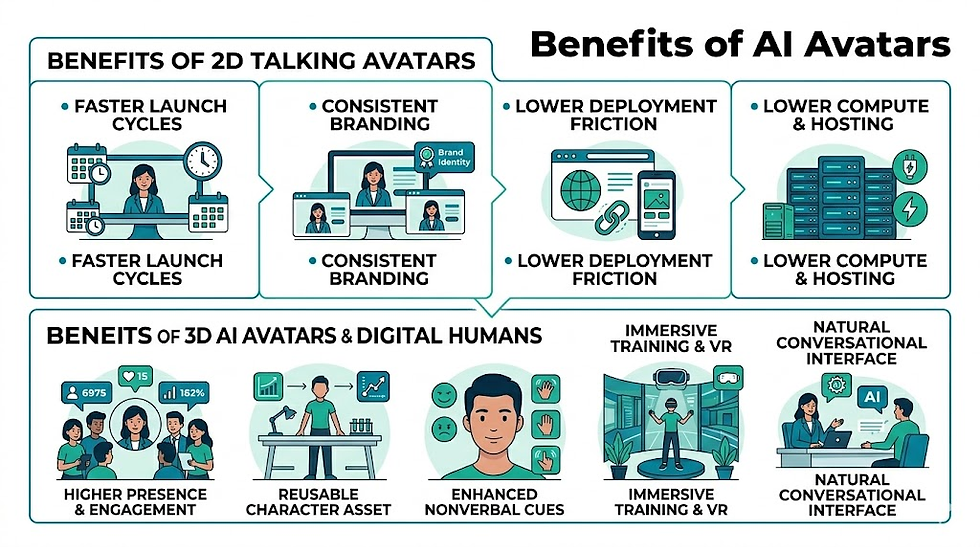
Whether you choose 2D or 3D, the business outcomes are measurable when the system is designed with intent.
Benefits of 2D talking avatars
Faster launch cycles for campaigns and internal comms
Consistent spokesperson delivery across languages
Lower deployment friction on web and mobile
Lower compute and hosting needs
Benefits of 3D AI avatars and digital humans
Higher perceived presence and engagement in interactive contexts
Reusable character asset that can evolve over time
Better nonverbal communication through gesture and gaze
Stronger fit for immersive training, VR, and experiential marketing
A more natural container for conversational AI, where the character feels like an interface, not a video
When stakeholders ask which option is “better,” the honest answer is that each is better at a different job. The procurement win comes from defining the job precisely.
Future Outlook
The next phase of avatar adoption is not about prettier faces. It is about behavior.
We are moving from scripted delivery into real-time interaction where a character must understand intent, handle interruption, respect privacy constraints, and respond with appropriate emotional timing. In that world, the differentiator will be orchestration: how speech, reasoning, animation, and safety rules work together.
Real-time engines will continue to reduce the cost of high quality 3D rendering. Motion capture and performance systems are becoming more accessible, which means more teams can build believable digital humans without cinema-level budgets. At the same time, governance expectations are increasing. Consent, disclosure, and identity protection will be non negotiable, especially when avatars represent real people.
As this space matures, many businesses will treat a 3D AI avatar as a long-lived product asset, similar to a brand design system. That is why studios and platforms are investing in repeatable pipelines that cover scanning, rigging, animation systems, voice, and deployment controls. For teams planning a serious roadmap, it is worth aligning the avatar decision with enterprise grade expectations such as scalability, access control, and monitoring, which are core concerns in production environments.
How to Choose Between a 3D AI Avatar and a 2D Talking Avatar
A useful choice begins with the experience, not the rendering label. A 2D talking avatar is often efficient when the character appears inside a fixed video frame, learning module, product walkthrough or website panel. A 3D AI avatar becomes more valuable when viewers must see the character from different angles, move through a virtual environment or interact with objects and spatial interfaces.
Separate the visual format from the intelligence layer. A prerecorded 3D character is not automatically conversational, and a 2D presenter can still connect to speech recognition, a language model, approved knowledge sources and business systems. Define whether the avatar must answer questions, complete tasks, remember context or simply deliver controlled content before comparing production approaches.
Production scope also differs. Two-dimensional presenters can be created quickly for campaigns that need many scripts, languages or frequent updates. Three-dimensional characters require modeling, rigging, animation tests, lighting and rendering decisions, but the resulting asset can support new scenes, camera angles and real-time experiences without rebuilding the identity from the beginning.
Define the audience, task and channel before selecting the format.
Document source material, review ownership, accessibility and escalation rules.
Pilot one measurable journey and expand only after user validation.
Performance matters on every target device. A high-quality 3D experience may need careful optimization for browsers, mobile hardware, kiosks or headsets. A 2D stream is usually easier to deliver on modest devices, although video size, encoding and network conditions still affect loading. Prototype on the lowest-spec device and connection the audience is expected to use.
Brand fit should guide realism. Photorealism can suit premium demonstrations or digital-human experiences, but it raises expectations for facial motion, eye behavior and voice synchronization. A stylized 3D character may feel more expressive and forgiving. A well-designed 2D presenter can feel clear and trustworthy when consistency matters more than spatial presence.
Estimate total ownership rather than only the first asset. Include script updates, localization, new animations, hosting, integration, moderation, analytics and accessibility. The most economical format is the one that supports the expected content volume and interaction model without recurring work that erases the initial saving.
A phased decision reduces risk. Start with one high-value journey, define success measures such as completion rate, qualified enquiries or support resolution, and test both a lightweight and advanced version when possible. Use observed audience behavior to justify the next investment instead of assuming the most realistic character will automatically perform best.
Related Mimic Minds Resources
Explore the related Mimic Minds guides linked throughout this article.
Frequently Asked Questions
What is the main difference between a 2D talking avatar and a 3D AI avatar?
A 2D avatar is presented as an image, video or two-dimensional animation. A 3D avatar is a spatial model that can be posed, lit and viewed from different angles. Either format can be prerecorded or connected to conversational AI.
Is a 3D avatar always more realistic?
No. Three-dimensional assets can be stylized or photorealistic. Perceived realism also depends on animation, facial timing, voice, lighting and behavior.
Which avatar format is faster to launch?
A 2D talking-avatar workflow is usually faster for fixed-frame videos and repeated scripted content. A 3D workflow takes more setup but can support reusable scenes, movements and real-time experiences.
Can a 2D avatar answer questions in real time?
Yes. A 2D interface can connect to speech recognition, language models and business systems. Conversational capability is separate from visual format.
When is a 3D AI avatar worth the investment?
It is most useful when spatial movement, multiple camera views, immersive environments, interactive products or long-term reuse across 3D channels creates business value.
Which option works better on mobile devices?
Both can work on mobile. Two-dimensional video is generally simpler, while 3D experiences require careful asset, rendering and interaction optimization.
How should a company compare cost?
Compare total ownership: creation, updates, localization, animation, hosting, integration, moderation and analytics.
Can a company begin with 2D and move to 3D later?
Yes. A phased approach can validate the script, audience need and business journey before a more advanced 3D implementation.
Conclusion
The best way to decide between a 2D talking avatar and a 3D AI avatar is to stop thinking of it as a graphics choice and treat it as an interface decision.
If your goal is fast, scalable, presenter style communication, 2D is efficient and often the quickest path to visible ROI. If your goal is an embodied brand presence that can move across channels, answer questions in real time, and live inside interactive environments, a 3D digital human becomes a durable asset with compounding value.
In the end, buyers should choose the avatar that matches where their customers actually are. Flat screens reward clarity and speed. Immersive and interactive experiences reward embodiment and behavior. And when your roadmap points toward characters that operate as living interfaces, building a real-time 3D avatar is not a luxury, it is architecture.
For further information and in case of queries please contact Press department Mimic Minds: info@mimicminds.com


Comments