
AI Influencers vs Human Influencers: Who Actually Wins?
- Mimic Minds
- Nov 22, 2025
- 6 min read
Updated: Apr 10

In the era of rapid digital transformation, brands are exploring new forms of online representation. Among the most striking emerging trends is the rise of AI influencers, virtual personalities generated using artificial intelligence. These digital personas are reshaping how companies build brand awareness, personalize content, and connect with global audiences.
But as AI-generated creators become more sophisticated, a critical debate has emerged: AI Influencers vs. Human Influencers - which is more effective, more engaging, and more trustworthy?
This in-depth guide breaks down the differences, benefits, challenges, workflows, and future outlook of both. Whether you're a marketer, content creator, or business leader, understanding this dynamic landscape is essential for staying competitive.
Table of Contents
What Are AI Influencers?
AI influencers are computer-generated digital personalities crafted using technologies like 3D modeling, motion capture, conversational AI, and machine learning. They can look hyper-realistic, stylized, cartoonish, or entirely fictional—depending on the brand’s goals.
These virtual creators are becoming mainstream thanks to advancements in AI avatars, agency-level automation, and conversational AI systems. For a deeper look at how AI-powered agents function, see the resource on Conversational AI Agents: How They Work.
Key characteristics of AI influencers:
Never age, get tired, or experience scandals.
Completely customizable for storytelling.
Can speak any language (enhanced by multilingual AI avatars).
Can be deployed across platforms 24/7.
Entirely owned or licensed by brands.
What Are Human Influencers?
Human influencers are real individuals who have built credibility, authenticity, and community around their persona. Their influence comes from:
Personal experience.
Emotional relatability.
Lifestyle storytelling.
Social proof.
Human influencers thrive due to their genuine connection with their audiences—something brands have relied on for years.
Want your own AI influencer? Mimic Minds builds custom AI influencer avatars for brands - choose the look, voice, and personality. Create yours free with Mimic AI Studio →
AI Influencers vs. Human Influencers: Key Differences

Understanding the comparison begins with examining how each type operates in the digital ecosystem. Human influencers bring lived experiences, whereas AI influencers bring controlled precision.
Differences include:
Emotional authenticity.
Scalability.
Cost.
Content personalization.
Speed.
Risk management.
Ethical concerns.
These distinctions shape how brands choose the right fit for campaigns—from personal branding with virtual tools (learn more: AI Avatars for Personal Branding) to full-scale marketing automation.
How AI Influencers Are Created
The creation of an AI influencer involves several stages—often blending creative design, 3D technology, voice synthesis, and generative AI. Companies like MimicMinds specialize in these systems.
The Process
Concept & Character Design: Define personality traits, visual style, backstory, tone, and unique look.
3D Modeling & Animation: Realistic or stylized models built using CGI tools. Motion capture, as explored in AI in the Entertainment Industry articles, is often used for realism.
Voice & Conversational Modeling: AI voices or cloned voices combined with conversational AI systems. (Related reading: Conversational AI vs. Chatbots)
Behavior & Content Automation: Generative AI scripts allow them to:
Post content.
Respond to followers.
Hold conversations.
Host live streams.
Deliver branded messages.
Deployment Across Platforms: Instagram, TikTok, YouTube, virtual events, and even the metaverse.
Advantages of AI Influencers
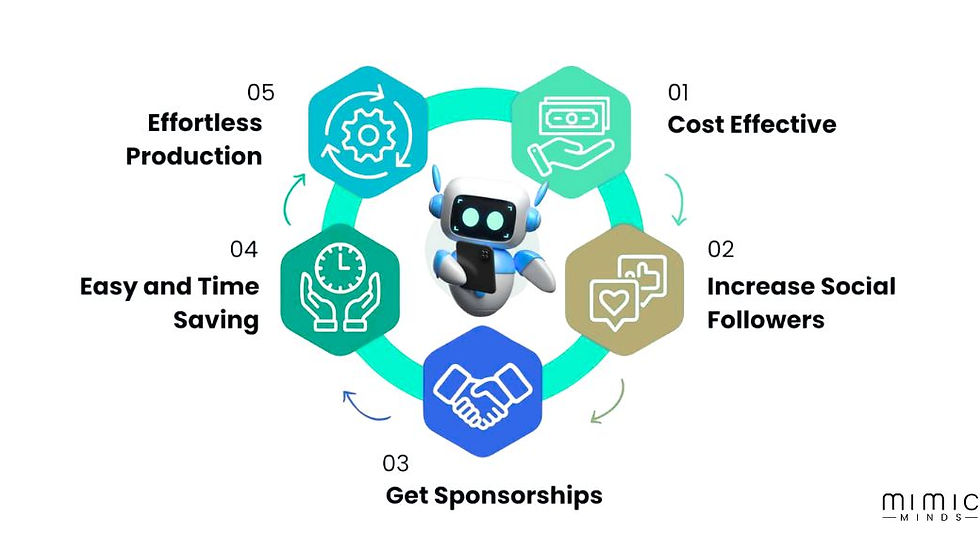
AI influencers provide power and flexibility that are impossible to achieve with human creators.
Major benefits include:
Total creative control: Their entire personality is crafted and managed by the company.
Low risk & brand safety: No scandals, no unpredictability.
Scalability & consistency: They can produce content at high volume, with consistent quality.
Cost-effective long-term: Initial creation may be high, but usage is nearly infinite.
Global reach: With multilingual capabilities, they engage audiences in different regions using AI-speaking avatars.
Unlimited customization: Change outfits, backgrounds, voice, or personality instantly.
Availability 24/7: AI influencers never need rest, travel, or negotiation.
Advantages of Human Influencers
Human influencers remain powerful and irreplaceable in many contexts.
Primary advantages:
Authenticity & emotional resonance: True human emotions and life experiences.
Community trust: Audiences follow them because of genuine loyalty.
Relatability: People connect with humans who share real stories.
Creativity & cultural understanding: Humans understand nuance, context, and social trends.
Organic content creation: They bring spontaneity and fresh thinking that AI lacks.
AI influencer vs human influencer: side-by-side comparison
Feature/Factor | AI Influencers | Human Influencers |
Authenticity | Low to medium | High |
Scalability | Extremely high | Limited |
Cost Over Time | Low | Medium–High |
Speed of Content Production | Instant | Slow–Moderate |
Emotional Relatability | Limited | Strong |
Creativity | High (programmed) | High (human expression) |
Risk & Scandal Potential | None | High |
Multilingual Communication | Instant via AI | Limited |
Brand Control | Complete | Partial |
Global Availability | 24/7 | Limited by schedule |
Applications Across Industries

AI and human influencers serve unique roles depending on the industry and campaign goals. With rising trends like virtual brand ambassadors, brands are pushing the boundaries of identity and engagement.
Where AI Influencers Shine
Marketing & Advertising: Automated yet personalized video marketing (supported by AI avatars).
eCommerce & Product Demos: They can instantly generate product showcases in multiple languages.
Entertainment & Virtual Production: Growing use cases appear across gaming, film, and metaverse environments (See: AI in the Entertainment Industry).
Customer Experience: They serve as hyper-realistic virtual brand ambassadors, automating customer interactions.
Where Human Influencers Excel
Lifestyle & Fashion: Being real boosts relatability.
Travel & Experience-Based Content: Humans can share real emotions and reactions.
Social Movements & Trust-Based Campaigns: Authentic voices matter.
Challenges & Ethical Considerations

Both AI and human influencers bring challenges that brands must navigate strategically.
Challenges for AI Influencers
Authenticity concerns: People may feel deceived if they don’t know the influencer is AI.
Ethical transparency: Should AI influencers disclose that they're artificial?
Regulation: Laws around virtual identity, synthetic media, and ownership are still evolving.
Bias & Representation: If not designed properly, AI models may perpetuate stereotypes.
Challenges for Human Influencers
Scandals & reputation risk: Humans can be unpredictable.
Contracting & negotiation: Costs and agreements can be complex.
Burnout & pressure: Influencing is relentless and mentally taxing.
Limited scalability: Humans can only do so much in a day.
Future Outlook: AI-Driven Influence

The future isn’t AI influencers vs. human influencers — it's both working together.
Future Trends
Hybrid influencer models: Humans partnering with AI versions of themselves using virtual brand ambassador technology.
Agentic AI personalities: More autonomous virtual influencers enhanced by the evolution of agentic AI (related article: Agentic AI vs Generative AI).
Metaverse-native stars: Celebrities existing only in virtual worlds.
Multilingual global influencers: Powered by instant translation and adaptive AI communication.
Personalized influencer experiences: Every user can have their own AI-created influencer for customized content.
Brands that adopt virtual influencers early—especially alongside human creators—will be positioned to stand out in the next wave of digital marketing.
FAQs: AI Influencers vs. Human Influencers
1. Are AI influencers better than human influencers?
It depends on your goal. AI influencers are better for brand consistency, cost efficiency, multilingual reach, and 24/7 availability. Human influencers are better for authentic storytelling and established audience trust. Many brands in 2026 use both.
2. How much does an AI influencer cost?
Creating an AI influencer with platforms like Mimic Minds is significantly cheaper than hiring human influencers long-term. There's a one-time creation cost rather than per-post fees, making AI influencers ideal for sustained campaigns.
3. Are AI influencers trustworthy?
They are brand-safe and predictable, but may lack emotional authenticity.
4. Can AI influencers create their own content?
Yes. With generative and agentic AI, they can post, respond, and create media autonomously.
5. Can brands own their AI influencer?
Yes. When you create an AI influencer through Mimic Minds, the avatar is fully owned by your brand - you control the appearance, voice, content, and usage rights.
6. What brands use AI influencers?
Fashion, beauty, gaming, and e-commerce brands were the first adopters. In 2025, healthcare, education, and enterprise companies are increasingly using AI avatars as brand ambassadors and spokespeople.
7. Do AI influencers require disclosure?
For transparency, brands should clearly indicate when the influencer is AI-generated.
8. How do AI influencers communicate in different languages?
Through multilingual AI avatar systems that enable instant language switching.
Conclusion
The debate between AI Influencers vs. Human Influencers isn't about replacing one with the other. Instead, it's about understanding their strengths, limitations, and opportunities. AI influencers bring unparalleled scalability, creativity, and brand safety, while human influencers deliver emotion, authenticity, and trust.
Together, they form the future of modern marketing—one that blends artificial intelligence with human storytelling.
MimicMinds leads the charge in virtual influencer development, AI avatars, conversational agents, and next-generation brand ambassador systems. Whether you want a fully customized AI influencer or hybrid human-AI brand strategy, our technology and expertise pave the way for the future of influence.
Want your own AI influencer? Mimic Minds builds custom AI influencer avatars for brands - choose the look, voice, and personality. Create yours free with Mimic AI Studio →
For further information and in case of queries please contact Press department Mimic Minds: info@mimicminds.com.


Comments