
AI Avatar Keynote Speakers: Uses, Benefits and Event Planning

Updated: 7 days ago

What if your next keynote speaker never misses a cue, speaks every language your audience needs, and can deliver the same story flawlessly in Mumbai, Dubai, and New York on the same day?
That is the real conversation behind AI avatar keynote speakers. Not a gimmick. Not a novelty act. A new kind of stage presence built from performance craft, real-time rendering, and conversational intelligence. When designed properly, a digital human can carry a conference moment with the same gravitas as a human presenter, while unlocking formats a traditional keynote cannot.
This article breaks down what it actually takes to put a believable AI driven speaker on stage, where it shines, where it fails, and how to decide if a virtual keynote fits your event’s intent, budget, and audience expectations.
Table of Contents
What an AI Avatar Keynote Speaker Really Is
An AI avatar keynote speaker is not just a face on a screen with a scripted voiceover. The credible versions are built like screen characters, then deployed like live systems.
At a practical level, a stage-ready digital human usually blends four layers:
Visual identity and character design: facial likeness, wardrobe, micro details that read well on LED walls
Performance layer: motion capture, keyframe animation, or live puppeteering for body language
Voice system: studio quality text to speech, or a cloned voice with explicit consent and contractual control
Intelligence layer: scripted talk plus optional conversational AI for audience questions, booth interactions, or moderated panels
If your event needs a polished keynote that lands like cinema, the avatar behaves like a performer. If your event needs Q and A, it behaves like a hosted AI system with guardrails.
For teams evaluating a complete build and deployment workflow, the most direct overview is the platform level view inside the Mimic AI Studio, because it frames the avatar as a controllable production asset rather than a one off demo.
Why Conferences Are Exploring Digital Human Speakers
Conference programming is under pressure. Audiences want spectacle, clarity, and substance, without long windups or generic slides. Meanwhile organizers are balancing cost, logistics, speaker availability, and global reach.
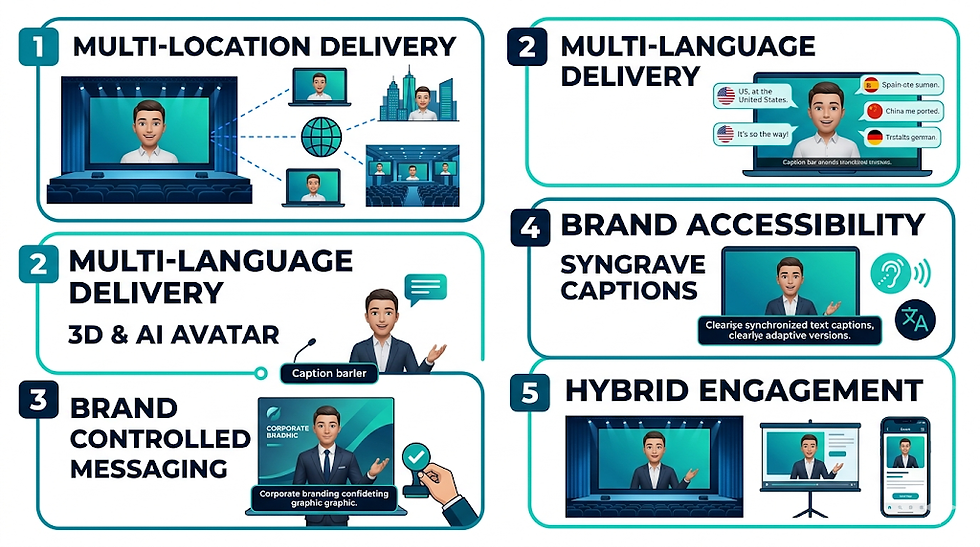
A well built AI avatar keynote is being considered because it can solve specific event problems:
Multi location delivery: one keynote, multiple venues, consistent tone and timing
Multi language delivery: localized voice and subtitles without losing the speaker’s cadence
Brand controlled messaging: fewer variables than a guest speaker touring ten cities
Accessibility: clearer pacing, on-screen captions, and adaptive versions for different audiences
Hybrid engagement: the same character can appear on the main stage, then in breakout rooms, then in the event app
The important nuance is this: the show stealing version is not the most futuristic one. It is the one that respects conference rhythm. Strong opening. Clear narrative arc. Designed pauses. Visual emphasis that works on a massive screen. You are still directing a performance.
If your keynote is tied to a commercial announcement or a partner narrative, the most common fit is an avatar designed for enterprise style communication, similar to what the AI avatar for business use case focuses on.
The Production Pipeline Behind a Stage-Ready Digital Human

If you want a digital human to hold attention for twenty minutes on a conference screen, you have to build it like you would build a lead character for film, with event engineering layered on top.
1 Identity and likeness decisions
First decide whether the keynote avatar represents:
A real person: CEO, founder, spokesperson, or expert
A fictional brand character: designed mascot with human credibility
A hybrid presenter: stylized but still grounded in realistic performance
Real person likeness demands strict consent, usage scope, and revocation policies. The audience should never feel tricked. That trust dynamic matters more on stage than in a marketing video.
2 Asset creation: model, textures, and rig
A stage asset must survive close ups and wide shots.
Typical build steps include:
High resolution head model and scan based detail or sculpted realism
Physically plausible skin shading and eye rendering tuned for LED walls
Facial rig for speech shapes, emotion beats, and micro expressions
Body rig that supports natural posture shifts, gestures, and turns
If your conference audience includes creators, engineers, or VFX professionals, they will subconsciously evaluate the rig. Bad facial weights and dead eyes break belief instantly.
3 Performance: mocap, animation, or live control
Keynote delivery is rhythm. That rhythm comes from performance capture decisions.
Common approaches:
Pre captured performance: full body and face capture for a locked talk
Hybrid: captured base performance with hand keyed refinements for emphasis
Live puppeteering: operator driven body language synced to speech for dynamic segments
For most conferences, the best result is pre captured with selective refinements. It reduces risk and keeps the pacing cinematic.
4 Voice: studio quality, not “AI voice”
Audience tolerance for synthetic speech is improving, but conferences are unforgiving. A keynote voice must feel intentional.
Best practice looks like:
Scripted voice recorded by a real actor, or consented voice model built from clean sessions
Direction for emphasis and breath so it does not feel like an audiobook
Audio mastering for venue acoustics and large speaker systems
5 Intelligence layer: scripted first, conversational second
The keynote itself is usually scripted. Conversation is optional and must be controlled.
If you want the avatar to answer questions, the safest approach is a moderated Q and A where:
Questions are filtered
The avatar is grounded to approved knowledge sources
The system has refusal behavior for unsafe or off topic prompts
A human producer can intervene
If you are building the system to interact beyond the main stage, explore a structured agent approach through AI agents, where the avatar becomes one interface for a governed knowledge and action layer.
Real-Time Delivery Formats for Events and Keynotes
There is no single “right” way to deploy a digital human keynote. The format depends on your venue, your risk tolerance, and whether you want interaction.
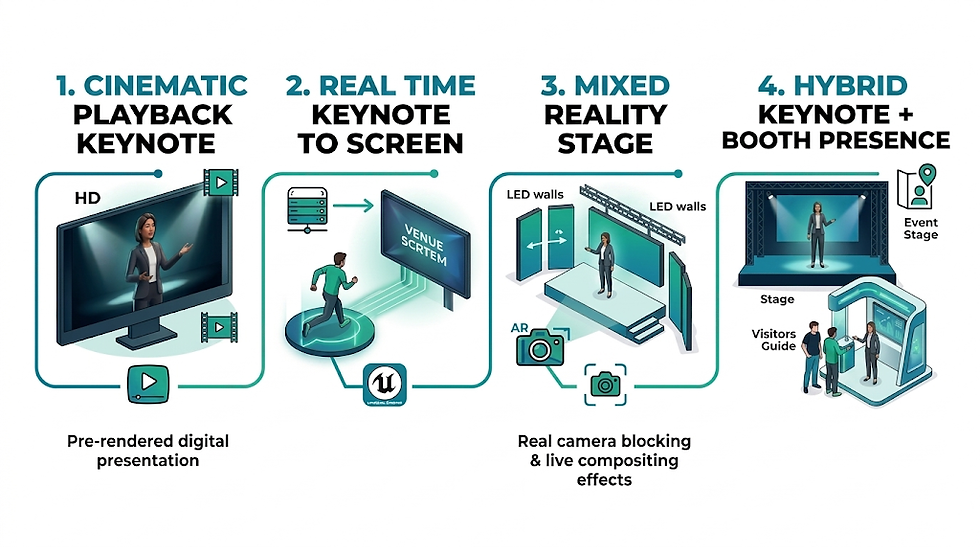
Common event formats include:
Cinematic playback keynote: pre rendered or real-time rendered video played like a film segment
Real-time keynote to screen: avatar runs in a real-time engine and outputs to the venue screen system
Mixed reality stage: avatar appears on LED walls with real camera blocking and live compositing
Hybrid keynote plus booth presence: the same character appears on stage, then later becomes an interactive event guide
If you are also running gaming adjacent events, esports programming, or creator focused conferences, a stylized but credible approach can be more culturally native. That is where an AI avatar for gaming style of character language often performs better than pure corporate realism.
Comparison Table
Approach Best For Strengths Risks Typical Production Needs
Human keynote speaker Prestige and authenticity Natural presence, live improvisation Travel, availability, inconsistency Speaker coaching, AV rehearsal
Pre produced avatar keynote Big reveal moments High polish, repeatable, cinematic No live Q and A Character build, animation, mastered audio
Real-time avatar keynote Hybrid and multi venue Live timing control, adaptable Technical failure risk Real-time engine, operator, venue integration
Avatar plus moderated Q and A Thought leadership at scale Audience interaction with control Requires governance and careful design Agent layer, safety rules, rehearsal
Panel with avatar co host Entertainment and pacing Keeps panels tight, bridges segments Can feel gimmicky if poorly written Scriptwriting, timing, character direction
Applications Across Industries
AI avatar keynote speakers are not limited to tech conferences. The strongest applications are where clarity, repeatability, and scale matter.
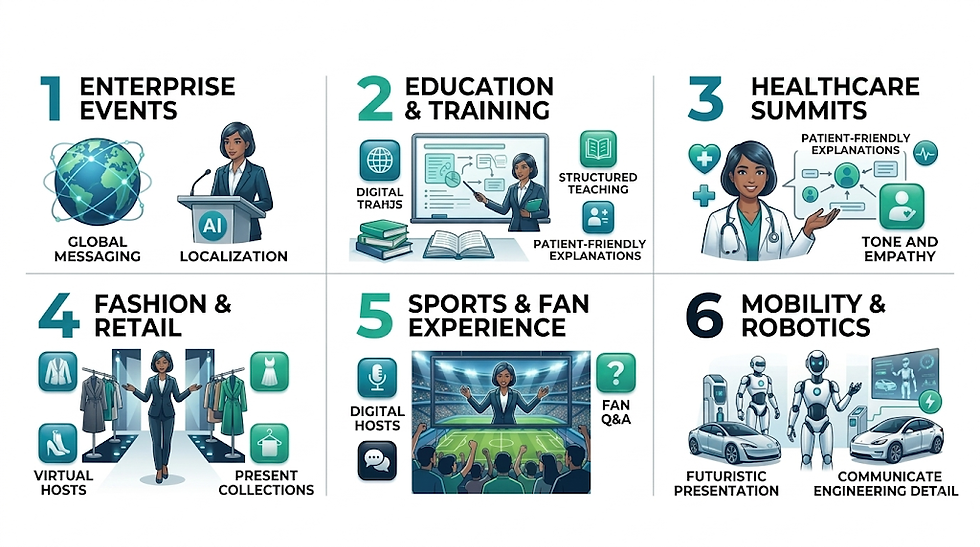
Enterprise events and product launches: consistent global messaging and localization
Education and training conferences: structured teaching segments and repeatable workshops
Healthcare and wellness summits: patient friendly explanations when tone and empathy are designed intentionally
Fashion and retail events: virtual hosts that can present collections and interact with attendees
Sports and fan experiences: digital hosts for halftime segments, fan Q and A, sponsor activations
Mobility and robotics conferences: futuristic presentation formats that still communicate engineering detail
If your event is in a regulated or high trust domain, choose a use case framework built for that audience. For example, a clinical or patient facing keynote needs a different tone and compliance posture, aligned with AI avatar for healthcare. A mindfulness or therapy adjacent summit should treat the avatar as a calm interface, more like AI avatar for wellness.
Benefits
A digital human can steal the show when the goal is not to replace people, but to deliver a moment people remember, with fewer constraints.
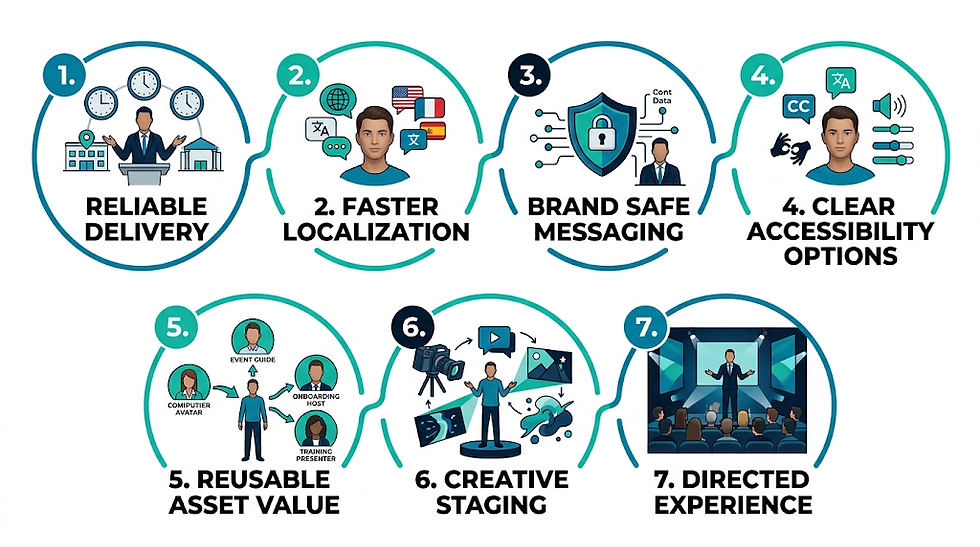
Key benefits conference teams typically care about:
Reliable delivery across multiple venues and time zones
Faster localization with consistent performance quality
Brand-safe messaging with controlled updates
Clear accessibility options: captions, pace variations, and language tracks
Reusable asset value: the same avatar can become an event guide, onboarding host, or training presenter
Creative staging: impossible camera moves, transitions, and visual metaphors that reinforce the story
Most importantly, an avatar keynote can turn your conference from a series of talks into a directed experience, closer to virtual production than a standard presentation.
Future Outlook
The next wave will not be about making avatars “more human” in a generic sense. It will be about making them more stage literate.
Expect improvements in:
Real-time facial nuance: better eye behavior, better mouth interiors, more natural micro movement
Safer conversational layers: better grounding, better refusal behavior, better moderation tools
Personalization at scale: one keynote delivered in many versions without losing authorial intent
Integration with event platforms: avatars that appear consistently across screens, apps, kiosks, and broadcast feeds
Hybrid pipelines: teams will mix motion capture, real-time engines, and AI assisted editing the same way modern virtual production mixes practical and digital
As this matures, the most valuable skill will be direction. Writing. Performance. Timing. Digital humans will become another kind of stagecraft, and the conferences that win will treat them like performers, not like software.
For organizations exploring whether they need a platform level deployment or a one time build, the broader ecosystem view on Enterprise solutions can help frame what governance, scalability, and rollout typically look like.
Planning an AI Avatar Keynote Speaker

An AI avatar keynote speaker is a digital presenter used to deliver or support an event session. It may present a scripted message, respond to selected questions, introduce speakers or appear as a branded character. The format can create a distinctive experience, but it should serve the event objective rather than function only as a visual novelty.
Start by deciding whether the avatar is scripted, interactive or hybrid. A scripted performance offers maximum control, while a live conversational segment can adapt to the audience but requires stronger knowledge, moderation and backup systems. A hybrid design often works well: pre-approved presentation content with carefully bounded interaction.
Planning, Controls and Production
Production planning should cover screen format, resolution, audio, lighting, playback, connectivity and latency. A virtual event needs reliable streaming integration, while a physical venue may use an LED wall, projection, holographic display or kiosk. Always test with the actual venue and equipment rather than assuming a studio preview will translate.
The character's role, voice and disclosure must be clear. Audiences should know whether the speaker is fictional, AI-assisted or based on a real person. If the avatar uses a person's likeness or voice, secure rights for the event, recording, promotion, reuse and any generated responses.
Choose scripted, interactive or hybrid presentation mode.
Define the avatar's role, content rights and disclosure.
Test venue displays, sound, network and backup playback.
Moderate live questions and prepare human intervention.
Measure message impact and event outcomes beyond novelty.
Measurement and Continuous Improvement
Interactive questions should use an approved knowledge set and visible moderation. Define topics the avatar can answer, how questions are selected and when a human host intervenes. Prepare fallback lines, prerecorded segments and a live operator for connectivity or model failures.
Measure the session against event goals such as attendance, message recall, participation, qualified leads and satisfaction. Collect qualitative feedback on clarity and relevance, not just whether attendees found the technology impressive.
Related Mimic Minds Guides
Frequently Asked Questions
What is an AI avatar keynote speaker?
It is a digital presenter that delivers scripted or interactive content at virtual, hybrid or physical events.
Can an AI avatar answer live questions?
Yes, when connected to approved knowledge and supported by moderation, boundaries and human intervention.
What equipment is required?
Requirements may include playback or rendering hardware, reliable audio, venue displays, streaming integration and network backup.
Can a keynote avatar use a real person's likeness?
Yes, with explicit permission covering likeness, voice, event use, recording, promotion and generated performance.
Should audiences be told that the speaker is AI?
Yes. Clear disclosure prevents confusion and supports trust.
What happens if the system fails during the event?
Use tested backup playback, prerecorded segments, fallback lines and a human host or operator.
Can the avatar present in several languages?
Yes, but pronunciation, translation, timing and cultural context should be reviewed for each audience.
How should event success be measured?
Track attendance, message recall, participation, leads, satisfaction and feedback about clarity and relevance.
Conclusion
A digital human can absolutely steal the show at your conference, but only if you treat it like stagecraft. The keynote must be written with intention, performed with believable rhythm, and delivered through a pipeline that respects both cinema quality and live event reliability.
When it works, it does something traditional keynotes struggle to do. It becomes a repeatable, global, controllable performance asset that can live beyond one day on a stage. It can open your event with precision, carry complex narratives with clarity, and reappear later as an event guide, educator, or interactive host.
The organizers who win with AI avatar keynote speakers will not be the ones chasing novelty. They will be the ones directing a real performance, built with the same care you would bring to a hero character in VFX, only tuned for the unforgiving honesty of a conference screen.
For further information and in case of queries please contact Press department Mimic Minds: info@mimicminds.com


Comments