
Digital Avatars Explained: How AI Avatars Work

Updated: 7 days ago

AI avatars are no longer a novelty that lives inside product demos. They are becoming a practical interface layer for brands that need to explain complex information, guide decisions, and support people at scale without sacrificing clarity or tone. When done well, an AI avatar feels less like a chatbot in a box and more like a consistent digital presence: a voice, a face, and a set of behaviors that make systems easier to use.
What is changing the game is not only better language models. It is the convergence of conversational intelligence, expressive animation, and production grade character pipelines. We now have the ability to design a virtual character with a defined role, deploy it across web and kiosks, connect it to business systems, and measure performance like any other product surface.
This pillar guide breaks down where AI avatars create real engagement and measurable efficiency, how the underlying workflow works, and what to watch for if you care about trust, safety, and long term adoption.
Table of Contents
Why AI Avatars Drive Engagement
Engagement is not magic. It is a design outcome. AI avatars can raise engagement because they turn information into an interaction. Instead of forcing people to read, search, or guess, a conversational digital human can ask clarifying questions, summarize, and guide the next step with a consistent tone.
Here are the engagement levers that matter most in real deployments
Presence and attention: a face and voice can hold attention longer than text alone, especially on kiosks, in lobbies, and on large displays
Social comfort: people often ask “simple” questions more freely to a nonjudgmental virtual assistant
Memory and continuity: the experience can remember preferences, repeat instructions, and stay consistent across shifts and locations
Narrative clarity: complex topics become easier when the avatar explains with examples, analogies, and step by step guidance
Brand coherence: the avatar becomes a recognizable “host” that keeps language and behavior aligned across channels
In sports and live entertainment environments, this presence effect is amplified because audiences already expect real-time guidance and fast answers, from schedules to venue logistics to fan engagement moments. If that’s your world, the industry deep dive in this guide to how AI is transforming sports experiences is a useful next read.
The Pipeline: From Character to Conversational System

A modern AI avatar is a system made of creative production, real-time runtime, and operational controls. Treating it as “just a model” is how teams end up with an uncanny face, an inconsistent personality, or a deployment that cannot be governed.
A practical pipeline usually includes these layers
Character design and identity: You define role, tone, audience, and boundaries first. Then you design the look. Some teams choose stylized characters for approachability. Others choose realistic digital humans for high trust scenarios. Either way, the identity must be intentional.
Asset creation and performance foundation: For higher fidelity avatars, production borrows from film and game pipelines: scanning or sculpting, grooming and hair, shading, rigging, facial blendshapes, and performance testing. If you want believable expression, you need a clean rig and an animation system that can map speech to facial motion without glitching.
Voice and dialogue stack: This is where speech to text, language model reasoning, and text to speech come together. The key is to control the voice so it stays on brand and does not drift in tone or vocabulary. For customer facing use, you also need fallback behaviors, safe responses, and clear handoff to humans.
Knowledge, tools, and integrations: The avatar should not guess. It should retrieve from trusted knowledge sources and call tools when needed: appointment booking, order lookup, account updates, policy retrieval, or form completion. Retrieval augmented generation and function calling patterns are typical here.
Real-time rendering and delivery: You choose where the avatar lives, such as a website, mobile app, kiosk, or AR display. Many teams use real-time engines for expressive rendering and low latency. The goal is to keep motion, lip sync, and response timing consistent so the avatar feels present.
Analytics and governance: If you cannot measure outcomes, you cannot improve. Track intent resolution, drop off points, escalation rate, sentiment signals, and repeat questions. For regulated industries, governance matters even more: policy constraints, audit trails, and human review loops.
This is also where financial services teams tend to start, because the cost of an incorrect answer is higher and guardrails must be explicit. A detailed look at practical patterns is covered in AI for financial services with real guardrails, especially if you need a conversational experience that is helpful without becoming risky.
Comparison Table
Approach Best for Strengths Tradeoffs Implementation notes
Text only assistant Fast deployment, low bandwidth environments Cheapest to build, easiest to iterate, high accessibility Lower attention, less emotional resonance, limited brand presence Invest in retrieval quality, safety layers, and clear UI handoffs
Voice assistant without a face Hands free contexts, call deflection, quick guidance Natural interaction, strong accessibility for many users Harder to show complex options, trust varies by scenario Use structured prompts, confirmations, and concise answers
Stylized AI avatar Retail, brand storytelling, education, onboarding Approachable, avoids uncanny valley, expressive with lighter assets May not fit high trust regulated contexts Define persona rules early and keep tone consistent across channels
High fidelity digital human Premium hospitality, enterprise front desks, healthcare guidance Strong presence, high perceived trust when executed well Higher production cost, higher expectations, needs strong rigging and audio sync Use film grade asset discipline and test across devices and lighting conditions
Agentic AI avatar with tool use Service workflows, bookings, case triage, knowledge heavy support Resolves tasks end to end, measurable efficiency gains Requires careful permissions and audit logs Keep tools scoped, log every action, and build human approval where needed
Applications Across Industries
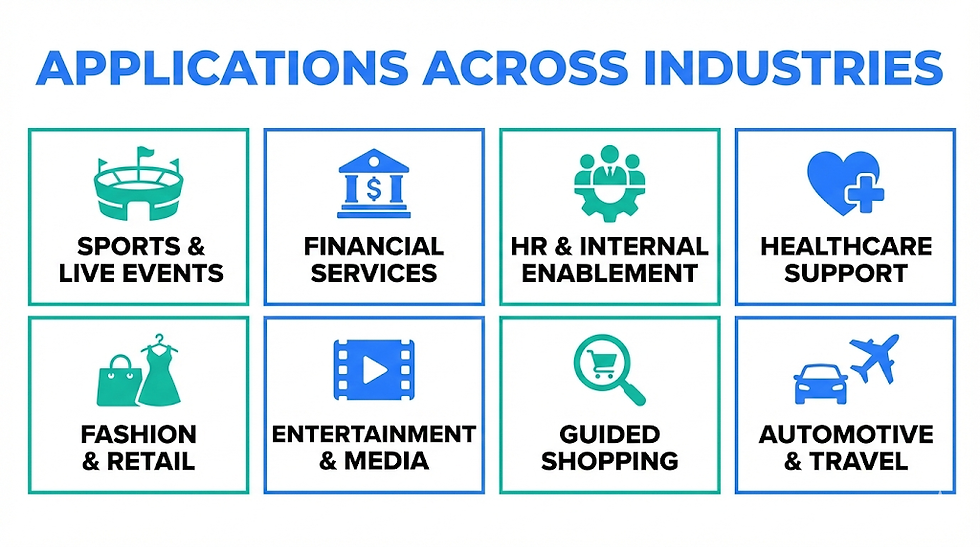
The most successful AI avatar deployments have one thing in common: a clear job to do. When the role is crisp, the avatar can be trained, evaluated, and improved like a real team member.
Below are industry clusters where conversational digital humans are already proving value. Each mini section includes a short summary and a read more link to your related cluster article.
Sports and live events
AI avatars can act as venue concierges, fan engagement hosts, and real-time information guides. Think wayfinding, schedule updates, accessibility support, ticket policy explanations, and sponsor activations that feel conversational rather than interruptive. For deeper use cases in this space, explore AI in sports and how it is transforming the game.
Financial services
In banking, insurance, and wealth contexts, avatars can handle routine questions, onboard customers, explain products in plain language, and triage service requests with strong constraints. The emphasis is accuracy, policy compliance, and clear escalation paths. Continue with AI for financial services use cases and guardrails for a tighter view of what is safe, what is valuable, and where humans must stay in control.
HR and internal enablement
HR teams can use AI avatars for employee onboarding, policy navigation, benefits guidance, and training support. The avatar becomes a consistent first line of help, while sensitive topics route to humans. The important design choice is what the avatar should never decide, even if it can answer. A focused breakdown is in AI in HR and where it helps versus where humans lead.
Healthcare communication and support
Healthcare is not only about information, it is about understanding. Avatars can support patient intake, appointment prep, medication reminders, post visit instructions, and empathetic education that adapts to literacy level. Safety comes from narrow scope, verified sources, and clear disclaimers paired with escalation. For a practical view, see AI in healthcare focused on communication and patient understanding.
Fashion and retail storytelling
In fashion, digital humans can become stylists, product explainers, and brand storytellers. They help customers explore fit, material, occasion, and pairing ideas, while also supporting interactive campaigns that feel personal. This is where stylized avatars often outperform realism because they read as intentional design rather than imitation. Read more in AI in fashion and how digital humans change retail.
Entertainment and interactive media
Entertainment teams use AI avatars as hosts, characters, and interactive companions. The value is continuity: the character can live across trailers, social, events, and in experience moments while staying in voice. It also changes production: writers can prototype dialogue, directors can test pacing, and producers can run A B experiments on engagement. A deeper look is in AI in the entertainment industry for characters, hosts, and experiences.
Guided shopping and product discovery
Shopping is decision fatigue. AI avatars reduce that fatigue by asking the right questions, narrowing options, and explaining tradeoffs in plain language. They can also connect to catalogs, size guides, inventory, and return policies, turning browsing into guided discovery. Continue with shopping with AI avatars and the future of guided discovery.
Automotive, transit, and travel support
In automotive and mobility settings, avatars work well as transit assistants, city guides, and in-cabin support. They can explain features, troubleshoot common issues, guide charging or service steps, and support travelers with multilingual help at kiosks and terminals.
Benefits

AI avatars earn their place when they improve outcomes you can measure, not when they simply look impressive.
Common benefits teams see
Higher completion rates for onboarding, forms, and guided flows because the avatar reduces confusion
Better engagement time and return visits when the experience feels like a helpful host rather than a static FAQ
Faster support resolution for routine questions through retrieval and tool-based actions
Consistent tone and messaging across regions, shifts, and channels
Lower operational load for human teams, with clearer escalation for edge cases
Improved accessibility through voice, multilingual support, and simplified explanations
Stronger brand recall because the interface has identity, not just UI components
Efficiency gains also show up in training. When policies change, you update the knowledge layer and scripts, not hundreds of human variations. For organizations that operate across many locations, this consistency becomes a real cost reducer.
Future Outlook

The next phase is not simply better faces or smarter models. It is tighter orchestration between real-time performance, tool use, and safety.
What to expect
More real-time expressive control, including better eye contact, micro expression, and emotion aligned prosody
Deeper integration with enterprise systems so avatars can complete tasks, not only answer questions
Stronger evaluation frameworks, including automated testing for policy compliance and consistency
Better personalization that respects consent, with user controlled memory and transparency
A blend of virtual production techniques and AI, where character creation, animation, and dialogue iteration become faster without lowering craft
In practice, the best deployments will look less like an experiment and more like a new interface standard. A well built digital human will sit beside search, forms, and apps as a primary way people get things done.
How Digital Avatars Work in Practice

A digital avatar is a visual representation of a person, character or assistant. AI avatars add capabilities such as speech recognition, language generation, knowledge retrieval, synthetic voice and responsive animation. They can appear in video, websites, kiosks, events, games and immersive environments.
Avatars range from stylized 2D characters to photorealistic 3D humans. Some are prerecorded presenters, while others respond in real time. The right level of realism depends on the audience, channel, performance budget and whether expression, demonstration or brand identity improves the task.
Planning, Governance and Integration
A conversational avatar receives text or speech, interprets the request and retrieves relevant information. A language model prepares a response within defined rules, voice synthesis produces audio and the animation system coordinates lip movement, gaze and expression. Streaming helps reduce the delay between these stages.
Business applications include customer guidance, training, sales support, onboarding, event hosting and entertainment. An avatar is most useful when visual presence helps people understand, trust or remember information. For quick background tasks, a simpler text or voice interface may be more efficient.
Choose visual style and realism for the audience and channel.
Ground responses in approved, current information.
Design voice, animation and turn-taking as one experience.
Provide disclosure, accessibility and human escalation.
Monitor accuracy, latency, completion and user feedback.
Measurement and Responsible Deployment
Trust requires clear disclosure and reliable knowledge. Users should know they are interacting with a digital system and how to reach a person. Answers should come from approved sources, and the avatar should acknowledge uncertainty rather than inventing information with a confident face and voice.
Deployment includes more than character creation. Teams need content ownership, integrations, accessibility, privacy, monitoring, device testing and procedures for updating knowledge. Success should be measured through task completion, accuracy, satisfaction and business outcomes.
Related Mimic Minds Guides
Frequently Asked Questions
What is a digital avatar?
It is a visual representation of a person, character or assistant used in digital experiences.
What makes an avatar an AI avatar?
AI capabilities can let it understand input, retrieve knowledge, generate responses, speak and animate responsively.
What types of digital avatars exist?
Common types include 2D, 3D, stylized, photorealistic, prerecorded and real-time interactive avatars.
Where are AI avatars used?
They are used in customer service, training, sales, events, entertainment, games, websites and kiosks.
Do AI avatars need to be realistic?
No. Stylized characters can be more appropriate, efficient and comfortable for many audiences and brands.
How does an avatar speak?
Text-to-speech produces audio while animation systems synchronize the mouth, face and gestures.
Are AI avatars accurate?
Accuracy depends on knowledge, retrieval and controls, not visual realism. Systems still require testing and monitoring.
How should a company choose an avatar solution?
Compare use-case fit, quality, latency, integration, privacy, accessibility, governance and total operating cost.
Conclusion
The rise of AI avatars is not about replacing humans with a face on a screen. It is about creating a dependable interface that makes information easier to understand, decisions easier to make, and service easier to access at scale. The most effective implementations combine craft and control: a clear character role, a believable performance layer, reliable retrieval, and governance that protects users.
If you approach AI avatars as both a production asset and an operational system, you get the best of both worlds: engagement that feels human and efficiency that is actually measurable. That is the difference between an avatar that impresses in a demo and one that earns its place in a real organization.
For further information and in case of queries please contact Press department Mimic Minds: info@mimicminds.com.


Comments