
What Is the Uncanny Valley? Causes, Examples and Fixes

Updated: Oct 14
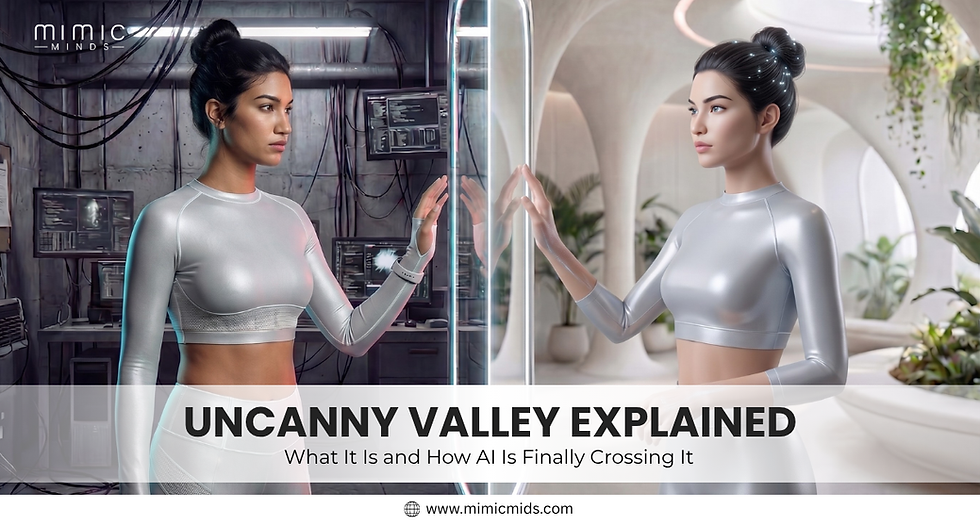
The uncanny valley is the uncomfortable feeling people can get when a digital human looks almost real but behaves slightly wrong. In AI avatars, that discomfort is rarely caused by one visual flaw. It usually comes from mismatch: realistic skin with unnatural eye movement, a human voice with robotic timing or a face that smiles without believable intent.
In 2026, the conversation has changed. AI avatars are no longer judged only by how photoreal they look. They are judged by whether they feel consistent, transparent and useful in the moment. A stylized avatar can fail if its motion feels lifeless. A realistic avatar can work well if gaze, facial timing, voice, context and disclosure are handled properly.
That is why the uncanny valley should be treated as a design and trust problem, not only a rendering problem. The goal is not to trick users into thinking the avatar is human. The goal is to create a digital human that feels clear, respectful and believable enough for the task.
Table of Contents
The Uncanny Valley Is Now About Trust, Not Just Realism
Recent avatar research shows that higher realism does not always reduce trust. In some information and education contexts, realistic avatars can be perceived as more trustworthy than stylized ones when the avatar is clearly presented and the interaction feels coherent.
For Mimic Minds, this supports a practical design principle: realism should be matched with purpose. A museum guide, healthcare explainer or enterprise trainer may benefit from a calm, realistic digital human. A gaming mascot, fashion character or brand ambassador may work better as a stylized character with expressive personality.
The safest approach is to design the avatar around user expectations. Add clear AI disclosure, keep facial expressions aligned with the voice, avoid over-polished speech and test the avatar with real users before launch.
Why the Uncanny Valley Happens

The Uncanny Valley is not about realism in general. It is about mismatch. Our brains are prediction machines, tuned for faces and social signals. When a digital human looks realistic but behaves like a puppet, the gap becomes obvious.
Here are the most common mismatch patterns that create the effect:
Eye behavior that does not track intention: A human gaze has purpose. It darts, settles, anticipates. A synthetic gaze that moves smoothly without micro corrections feels like a camera pan, not a mind.
Facial motion without muscle logic: Skin sliding across the face must follow underlying anatomy. If cheeks lift but the lower eyelid does not respond, or if lips move without tension changes, the face reads as “animated” even at photoreal resolution.
Timing that ignores breath and thought: Human speech contains pauses for cognition, breaths before emphasis, and tiny resets in posture. If audio is natural but the body never performs those resets, presence breaks.
Voice that lacks physicality: Even excellent voice generation can feel artificial when it has perfect smoothness, no micro strain, no saliva noise, no subtle pitch drift under emotion. The audience may not name it, but they feel it.
Lighting and shading that do not match context: A face can be perfectly modeled and still feel wrong if specular response is too uniform, subsurface scattering is missing, or the character does not share the same light logic as the environment.
In a modern digital human workflow, these problems are solvable. But they require treating realism as a system, not a shader.
If you are building conversational characters for real deployments, the safest path is to start with a controlled production pipeline where performance, voice, and rendering are tuned together. That is why teams often begin inside a purpose built environment such as the Mimic AI Studio, where the character is designed to hold up under close scrutiny rather than only in curated shots.
What Humans Actually Notice First

A useful truth: audiences forgive stylization. They rarely forgive inconsistency.
If your character is clearly animated, people accept it. The Uncanny Valley tends to appear when you aim for human realism but violate human expectations.
What viewers notice first is usually this order:
Eyes: Blink rate, eyelid contact, gaze targeting, pupil behavior, and focus changes.
Mouth and jaw mechanics: Lip compression, corner tension, jaw rotation, and how cheeks react to phonemes.
Head motion: Tiny nods, stabilizing movements, and how the neck responds to speech emphasis.
Voice alignment: Not just lip sync, but emotional sync. Does the face “mean” what the voice implies?
Micro expression coherence: A real smile affects more than lips. A real concern changes brow, eyes, and jaw tension in combination.
From a production standpoint, this is great news. It means realism is not infinite. It is prioritized. When teams focus on eyes, timing, and voice embodiment first, they climb out of the Uncanny Valley faster than teams chasing surface detail alone.
The Production Pipeline That Used to Cause the Problem

In classic VFX and animation, the pipeline was often segmented.
You might scan a performer, build the mesh, rig it, capture facial performance, clean it, animate fixes, light and render offline, then comp the shot. That pipeline can create stunning work, but it also encourages patchwork realism. A shot looks perfect from one camera angle because it was tuned for that angle. A close up works because a compositor corrected it. A performance feels right because an animator hand shaped a moment.
The moment you ask the same character to be interactive, those hidden supports disappear. A live audience can interrupt. A customer can ask an unexpected question. A learner can pause mid sentence. In that world, your character must be robust, not curated.
The most common failure points that push characters back into the Uncanny Valley in interactive settings:
Facial rigs that are accurate but not expressive under unpredictable phonemes
Lip sync that matches words but not intent
Audio generation that is natural but emotionally flat
Latency that makes responses feel delayed, like a puppet waiting for a cue
Inconsistent rendering across lighting conditions in real time
Solving this requires more than better models. It requires integration: character, conversation, voice, and rendering treated as one performance system.
That is where agentic systems also matter. When a character can plan responses, keep context, and behave with continuity, it stops feeling like a talking mask. It starts to feel like a persona. If your use case depends on that continuity, exploring structured conversational orchestration through AI Agents becomes part of the realism conversation, not just a software architecture choice.
What AI Changed, and Why It Matters Now

AI is “crossing” the Uncanny Valley in the same way a great actor crosses it: by making behavior believable, not just appearance.
Several shifts have made a practical difference:
Better facial solving and retargeting: Modern systems can map subtle performance capture onto rigs with less loss. The small movements that used to be crushed by cleanup now survive into final output.
Neural assisted rendering: Denoising, upscaling, and learned detail reconstruction can preserve realism in real time without requiring offline render budgets.
Voice generation that supports emotion and pacing: Newer pipelines can control cadence, emphasis, and warmth, reducing the “perfect announcer” problem.
Conversational memory and intent modeling: When a character can stay consistent across turns, it gains social credibility. Consistency is a core ingredient in escaping the Uncanny Valley.
Latency reduction across the stack: Believability is temporal. If the pause before an answer feels like thinking rather than loading, the viewer perceives mind, not machine.
In other words, the Uncanny Valley is being addressed through systems that honor performance. The character is no longer just a renderable asset. It is a live interface.
When you productize that interface, deployment details matter: where the character runs, how it scales, how you control tone, and how you protect brand and user trust. That is why teams building serious deployments typically evaluate platforms such as Enterprise solutions early, because realism without operational control is not a finished product.
Uncanny Valley Examples: Four Approaches Compared
The uncanny valley effect changes with the production approach. These four examples show where each method works best and where realism can break down.
Offline VFX digital humans: Highest visual fidelity for film and advertising, but expensive to revise and not designed for live interaction.
Traditional real-time characters: Fast and predictable for games or scripted kiosks, although facial nuance and voice timing can feel synthetic.
AI-assisted digital humans: Better facial detail, voice embodiment and iteration speed for training or customer service, but they require consistent controls and governance.
Conversational avatars with an agentic layer: Strongest context continuity and persona realism for enterprise, education and guided experiences, with greater integration and safety requirements.
Applications Across Industries

The most interesting thing about the Uncanny Valley is that it varies by context. A museum visitor may accept stylization if the story is strong. A patient may require calm realism, but also clear disclosure. A gamer may want expressive exaggeration, yet still demand authentic timing.
Here are real-world applications where crossing the Uncanny Valley produces measurable value:
Customer experience and brand front doors: A conversational digital human can greet, qualify, and route users while holding tone consistency across languages and channels.
Education and tutoring: An interactive tutor must feel patient, present, and attentive. When timing and gaze cues are right, learners engage longer and ask more questions. For education focused experiences, AI tutor avatars fit naturally because the persona must be supportive rather than purely informational.
Healthcare support and guided wellness: A virtual care companion must avoid uncanny behavior because discomfort reduces trust. The character should be clearly disclosed as AI, but still emotionally steady in delivery.
Sports and live commentary experiences: In sports, audiences are highly sensitive to timing. A host that reacts late feels fake immediately, even if the face looks perfect.
Gaming and NPC interaction: Players care less about pore level realism and more about responsive behavior, memory, and natural dialogue. That is why believable AI characters often outperform hyper realistic but scripted ones.
Retail and assisted shopping: A digital assistant that can demonstrate products, answer fit questions, and keep brand tone consistent becomes a scalable “face” of the store.
As your use case changes, the realism target changes with it. Exploring the broader set of domains on the Industries page helps teams align character design with audience expectations, so you solve the right version of the Uncanny Valley instead of chasing generic realism.
Benefits

Escaping the Uncanny Valley is not just a creative win. It has downstream business and production benefits when done responsibly.
Higher trust and lower user friction: If the character feels steady and coherent, users focus on the interaction, not the artifact.
Longer engagement time: Believable presence increases session length, repeat visits, and willingness to ask complex questions.
Reduced hand animation and shot specific fixes: A robust system reduces the need for constant manual patching.
Better brand consistency: A controlled persona can maintain tone, language, and behavior across teams and regions.
Scalable deployment without losing “human feel”: With the right governance, you can scale a digital human experience without creating a factory of uncanny outputs.
Clearer ethical disclosure: When the character design includes transparency and consent, users feel respected. That respect reinforces realism, because social trust is part of believability.
Future Outlook

The next phase of crossing the Uncanny Valley will be less about resolution and more about identity stability.
Expect progress in:
Consistent facial identity across scenes and devices: Characters will maintain the same “self” under different camera lenses, lighting environments, and compression levels.
Emotion that is controllable, not accidental: The goal is not to make an AI feel emotions, but to author performance with intention. Directors and brand teams need knobs, not surprises.
Real-time multimodal perception: When a digital human can perceive user tone, pause behavior, and visual context, it responds like a social participant, not a text box with a face.
Safer agentic behavior: As avatars become more autonomous, guardrails become part of the character rig, not an afterthought. Safety will be embedded in the persona design, conversation orchestration, and content policies.
Virtual production convergence: Film style performance capture will increasingly feed interactive systems. The line between a “shot” and a “session” will blur as engines and AI stacks converge.
In practice, teams that want to lead here will treat the avatar as a full pipeline asset: scanned or designed with correct topology, rigged for subtle expressivity, driven by a voice and conversation stack that respects timing, and deployed inside a system that can be observed and governed. The Uncanny Valley will not disappear, but it will become narrower, more predictable, and easier to avoid with craft.
Related AI Avatar Guides
FAQs
1. What is the Uncanny Valley in simple terms?
Uncanny Valley is the discomfort people feel when something looks almost human but not quite, especially when motion, eyes, or voice timing do not match human expectations.
2. Is Uncanny Valley only about visuals?
No. Visual realism can be excellent and still feel wrong if speech rhythm, gaze intent, and emotional timing do not align. It is a behavior and perception problem as much as a rendering problem.
3. Why do eyes matter so much in digital humans?
Humans read eyes as signals of attention and intention. If blinks, focus, and gaze targeting do not behave naturally, the audience senses absence of mind.
4. How is AI helping characters escape the Uncanny Valley?
AI improves temporal realism: better facial performance mapping, more natural voice pacing, lower latency responses, and stronger conversational continuity that feels like a stable persona.
5. Do stylized characters avoid the Uncanny Valley?
Often yes. Stylization sets expectations. Problems usually appear when a character aims for human realism but breaks human rules of motion and presence.
6. What is the biggest mistake teams make when building realistic avatars?
Chasing surface detail first. A high resolution face with weak timing, stiff eyes, or delayed response will still feel uncanny. Start with performance logic, then refine look.
7. Can Uncanny Valley be solved for live interactive use cases?
Yes, but it requires an integrated pipeline: rigging, facial solving, voice embodiment, conversation orchestration, and real-time rendering tuned together.
8. How do you keep an AI avatar ethical while making it realistic?
Be transparent that it is AI, avoid deceptive impersonation, respect consent and likeness rights, and implement governance so the character stays within safe, approved boundaries.
9. Is the uncanny valley still a problem for AI avatars?
Yes, but it is more manageable than before. The biggest risks are mismatch in eyes, timing, facial motion, voice and context.
10. Should AI avatars be realistic or stylized?
Choose realism when trust, expertise and clarity matter. Choose stylization when brand personality, fantasy or entertainment matters more.
11. How can brands reduce uncanny valley reactions?
Use natural gaze, believable facial timing, clear disclosure, consistent lighting, human fallback and user testing before deployment.
Conclusion
The Uncanny Valley used to be framed like a curse of realism: the closer you get, the worse it feels. In production reality, it is simpler and more useful than that. It is a signal that something in the performance system is inconsistent.
AI is finally crossing this gap because it is improving the parts humans instinctively test: timing, intent, continuity, and micro expression coherence. When those pieces hold together, people stop hunting for flaws and start responding socially. That is the real threshold.
For teams building digital humans today, the path forward is craft plus control. Build the character like a performance asset, not a decorative layer. Treat voice, facial motion, and conversation as one unified system. Deploy with governance, transparency, and operational observability. Do that, and the Uncanny Valley becomes less of a cliff and more of a checklist.
For further information and in case of queries please contact Press department Mimic Minds: info@mimicminds.com



Comments